
How Calgary’s freeze-thaw cycles crack driveways (and what actually stops it)
Most people think concrete cracks because it gets cold. It doesn’t. It cracks because it can’t decide whether it’s cold or not.
That distinction matters more in Calgary than almost anywhere else in Canada, and it explains why a driveway that would last thirty years in Toronto can look tired here in eight. The culprit is the chinook. When a warm wind rolls off the Rockies, our temperature can jump twenty degrees in an afternoon, thaw everything, then drop back below freezing overnight. Environment Canada records more of these swings for Calgary than for any other major Canadian city. Each one is a small act of demolition on your driveway.Patriarch Construction Concrete contractors in Calgary know how to do concrete right – with many generations of concrete knowledge.
What freeze-thaw actually does to concrete
Concrete is not solid the way a rock is. It’s full of microscopic pores, and those pores hold water. When that water freezes, it expands by roughly nine percent. That expansion pushes outward against the surrounding paste with real force. Thaw it, and the water contracts again. Do that once and nothing happens. Do it forty or fifty times a winter, year after year, and the paste fatigues the same way a paperclip snaps after you bend it back and forth enough times.
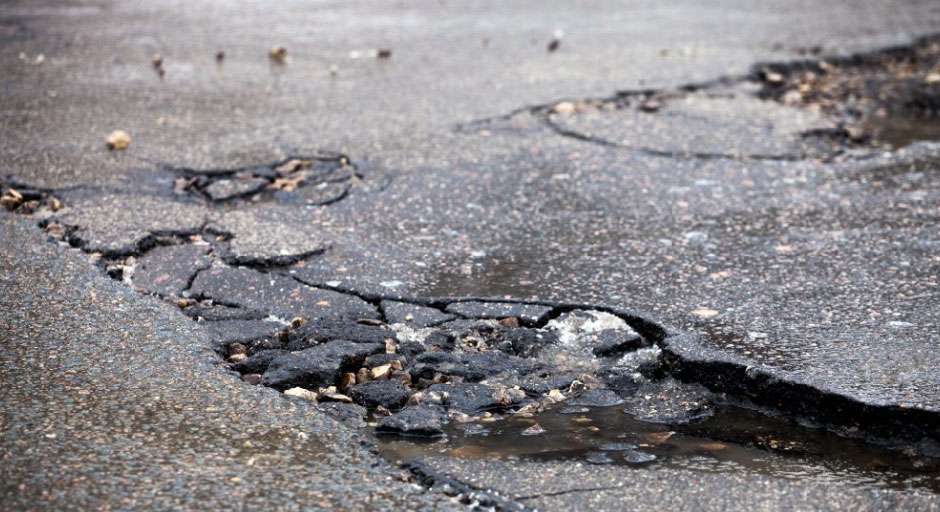
The first thing you see is usually scaling, where the top surface flakes off and exposes the aggregate underneath. Then come the fine surface cracks, then the wider ones that let in more water, which freezes, which widens them further. It feeds on itself. By the time a homeowner calls us, the driveway has often been failing quietly for two or three seasons.
Calgary makes this worse in two specific ways. Our chinooks mean the freeze-thaw count is unusually high, so the fatigue accumulates faster. And we salt our driveways and streets heavily, which drives the second problem.
The salt problem nobody warns you about
De-icing salt does not attack concrete chemically the way people assume. What it does is nastier. Salt lowers the freezing point of water and lets more of it soak into the slab before it freezes. So you end up with a more saturated slab going through each freeze cycle, which means more expansion, more pressure, more damage. Salt basically loads the gun that freeze-thaw fires.
This is why you often see the worst scaling right where you park, where snow melts off warm tires and drips salty slush onto the concrete. It’s not a coincidence. That’s the most abused patch of the whole surface.
You can’t really stop using salt in a Calgary winter, and I wouldn’t tell anyone to try. The answer is to build a slab that shrugs it off.
Air entrainment: the single most important thing
If you take one idea from this whole piece, make it this one. Concrete poured for a Calgary driveway must be air-entrained, and a lot of the failures I get called out to look at come down to concrete that wasn’t, or wasn’t enough.
Air entrainment means tiny air bubbles are deliberately mixed into the concrete, using an admixture, so the hardened slab is full of microscopic voids. When the water in the pores freezes and expands, it has somewhere to go. The bubbles act as pressure relief valves. Without them, the expanding ice has nowhere to escape and it fractures the paste from the inside.
For exterior flatwork in our climate, you want air content in the range of five to eight percent. That’s not a nice-to-have. The Alberta building code and CSA standards call for air-entrained concrete on exterior slabs exposed to freeze-thaw, and any contractor pouring a driveway here should be ordering it as a matter of course. If someone quotes you a suspiciously cheap driveway, ask them point blank what the air content of the mix is. If they can’t answer, keep calling.
Strength matters too, but not the way you’d guess
People fixate on the strength number, the megapascals, or the old PSI figure. Higher is better, roughly, but strength on its own won’t save a driveway from freeze-thaw if the mix isn’t air-entrained. I’d take a properly air-entrained 32 MPa mix over a non-entrained 40 MPa mix every single time for exterior work in Calgary.
For a residential driveway here, 32 MPa with proper air entrainment is a sensible spec. It gives you the surface durability to handle the scaling pressure and the strength to carry vehicle loads without cracking under weight. Going higher can help in high-traffic commercial situations, but for a home driveway it’s mostly the air content and the finishing that decide how long you get.
Drainage is half the battle
Water is the whole problem, so the less of it that sits on and under the slab, the longer the slab lasts. This is where a lot of driveways are lost before the concrete is even poured.
A driveway needs positive slope, ideally around two percent, so water runs off toward the street or a drain rather than pooling. It needs a proper compacted gravel base underneath, usually six inches or so of well-compacted granular fill, so meltwater drains away below the slab instead of saturating the ground and heaving it. In Calgary, where we also deal with expansive clay soils in many neighbourhoods, that base does double duty by giving the slab a stable, draining foundation that doesn’t swell and shift.
Skimp on the base and you get a slab sitting on wet, freezing ground. That’s frost heave, and it will crack even a perfectly mixed slab. I’ve seen beautiful concrete ruined by a four-inch base where it needed eight.
Control joints: telling the crack where to go
Concrete is going to move. It shrinks as it cures and it expands and contracts with temperature. You can’t prevent that, so the job is to control where the cracking happens. That’s what control joints are, those grooves cut into the surface. They create a weak line so that when the slab cracks, it cracks neatly along the joint instead of wandering across the middle of your driveway.
The spacing matters. A rough rule is that joints should be no more than about two and a half to three times the slab thickness apart, in feet, so a four-inch slab wants joints somewhere around ten feet or closer. Get the spacing wrong and the slab will crack wherever it wants. A good crew plans the joint layout before the pour, not after.
Sealing buys you years
A penetrating sealer soaks into the concrete and reduces how much water and salt the slab absorbs. Less absorption means less saturation, which means less freeze-thaw damage and less salt-driven scaling. For a Calgary driveway, resealing every couple of years is cheap insurance. I usually tell people to plan on it the way they plan on changing furnace filters. It’s routine maintenance, not a repair.
Timing matters. New concrete needs to cure before it’s sealed, usually about a month, and sealing is best done in dry, mild weather, which around here means late spring or early fall rather than the dead of a chinook-whipsawed winter.
What good looks like
Put it together and a driveway built to survive Calgary looks like this: a compacted gravel base of adequate depth, air-entrained concrete around 32 MPa, a proper two percent slope for drainage, control joints laid out on a sensible grid, a clean cure, and a maintenance sealer every year or two. None of it is exotic. All of it is the difference between a driveway that lasts a decade and one that lasts a lifetime.
How long should a Calgary driveway actually last?
A properly built concrete driveway should give you 25 to 30 years or more, even here. That surprises people, because so many Calgary driveways look rough at ten or fifteen. The gap between the two isn’t the concrete. It’s whether the driveway was built and maintained for this climate or just poured and forgotten.
The driveways that fail early almost always share the same short list of causes: a non-air-entrained mix, a thin or poorly compacted base, no sealing, and salt sitting on an unsealed surface winter after winter. The ones that last thirty years had air-entrained concrete, a solid base, and an owner who resealed every couple of seasons. Same city, same chinooks, wildly different lifespans, and the difference was decided by choices, not luck.
It’s also worth being realistic about what aging looks like. Even a good driveway will develop some fine cracking over decades, because concrete moves and Calgary pushes it hard. Fine, stable cracks along the control joints are normal and not a failure. What you’re trying to avoid is the deep structural cracking and widespread scaling that comes from the shortcuts above.
Repair, resurface, or replace?
When a driveway starts looking tired, homeowners tend to assume it’s replacement time. Often it isn’t. The right answer depends on what’s actually wrong, and it’s worth diagnosing before spending.
If the surface is scaling or lightly cracked but the slab underneath is sound and sitting flat, resurfacing is often an option. A bonded overlay goes over the existing concrete and gives you a fresh, sealed surface at a fraction of the cost of a tear-out. The catch is that resurfacing only works when the base and the slab beneath are still good, because an overlay can’t fix a foundation problem, it just hides it for a season.
If the driveway is heaving, has deep structural cracks, or sections have shifted to different heights, that’s usually a base or drainage failure, and resurfacing over it is throwing money away. At that point replacement, done properly with a corrected base and drainage, is the honest fix. The test I use is simple: if the problem is skin-deep, treat the skin; if the problem is the ground, you have to go back to the ground. A good contractor will tell you which one you’ve got, even when the cheaper answer is the one that’s better for you.
A few quick questions homeowners ask
Can you pour a driveway over an existing one? Generally not a good idea. A thin overlay of new concrete on an old slab without proper bonding and thickness tends to crack and delaminate. Resurfacing systems are designed for this; a plain second pour is not.
How soon can I drive on a new driveway? Foot traffic is usually fine after a day or two, but hold off on parking vehicles for about a week, and ideally closer to two weeks in cold weather, so the concrete can gain strength before it takes the load.
Does colour or stamping weaken a driveway? No. Decorative finishes are surface treatments and don’t reduce structural strength, though stamped surfaces need more diligent sealing and anti-slip treatment to hold up here.
The frustrating truth is that most of what kills Calgary driveways is decided in the first day of work, in the mix order and the base prep, long before anyone sees a crack. By the time the damage shows, the choices that caused it are buried under the slab. That’s why it pays to hire someone who treats the boring parts, the base and the mix spec, as the important parts, because in this climate they are.
If your driveway is already scaling or cracking, it’s worth having a Calgary concrete driveway contractor look at whether it can be resurfaced or whether the base is the real problem. A surface fix on a bad base just buys you a season. Fixing it properly, once, is almost always cheaper than fixing it cheaply twice.