
How Much Land Do You Actually Need for a Geothermal System?
One of the first questions homeowners ask when they start researching a geothermal system installation is whether their property can even support one. There is a persistent myth that geothermal heating and cooling is only for people with sprawling rural properties or estates with acres of open land. The truth is more encouraging. Thanks to vertical drilling and other loop configurations, geothermal systems now fit on lots that would have been disqualified twenty years ago.
That said, land does matter. The amount of usable space on your property determines which type of ground loop you can install, and the loop type is the single biggest factor in your total project cost. So before you fall in love with the idea of tapping the steady temperatures beneath your yard, it helps to understand what each system actually requires.
First, a Quick Refresher on How Ground Loops Work
A geothermal heat pump does not generate heat the way a furnace does. It moves heat. In winter, a mixture of water and antifreeze circulates through buried pipes, absorbing warmth from the ground and carrying it indoors, where the heat pump concentrates it and distributes it through your home. In summer, the process reverses, and the loop carries heat out of your house and deposits it into the earth.
The buried pipe network is called the ground loop, and it is the part of the system that interacts with your land. The heat pump unit itself sits inside your home and takes up about as much room as a large appliance. Everything that happens outside happens underground, which means the loop needs to be long enough and deep enough to exchange heat with soil that stays at a stable temperature year round.
Horizontal Loops: The Option That Needs the Most Room
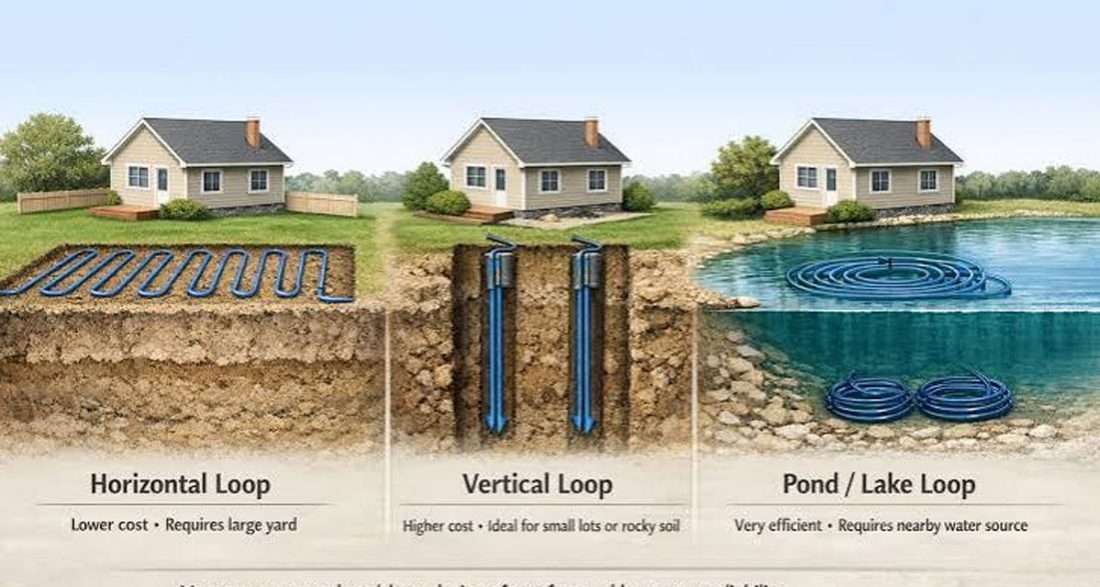
A horizontal closed loop is the most common and usually the most affordable configuration for homes with available land. Installers dig trenches, typically four to six feet deep, and lay pipe in long parallel runs before backfilling.
The general rule of thumb is that a horizontal loop needs somewhere between 400 and 600 square feet of land per ton of heating and cooling capacity. Most average homes need a three to five ton system, which translates to roughly 1,200 to 3,000 square feet of open, diggable ground. For a mid sized home, installers often estimate a quarter to three quarters of an acre of usable yard space.
A few important details affect that number. The land needs to be relatively open and accessible to excavation equipment. A large lot covered in mature trees, septic fields, pools, gardens, and outbuildings may have far less usable ground than its total acreage suggests. Soil type matters as well. Wet clay transfers heat more efficiently than dry sand or gravel, so a home in heavy clay soil may need less pipe than an identical home in sandy soil.
The upside of horizontal loops is cost. Trenching is cheaper than drilling, often by a wide margin. The downside is the footprint. If your lot is small, sloped, or crowded, a horizontal loop may simply not be an option.
Vertical Loops: Small Lots Are Not Disqualified
If horizontal loops are the reason people think geothermal requires acreage, vertical loops are the reason that belief is outdated. Instead of spreading pipe across a wide area, a drilling rig bores narrow holes straight down, usually 100 to 400 feet deep, and inserts pipe in a U shaped configuration.
A typical home needs somewhere between two and five boreholes, each only a few inches in diameter, spaced roughly 10 to 20 feet apart. The drilling rig needs access to those spots, but the total land disturbance is minimal. Once the drillers finish and the crew patches the boreholes, the evidence is barely visible.
This makes vertical loops the go to choice for suburban and even some urban lots. If you have a modest backyard, a side yard, or a strip of land along the driveway, a vertical system can usually work. The tradeoff is price. Drilling deep boreholes costs more than trenching, and vertical systems generally run several thousand to more than ten thousand dollars above a comparable horizontal installation, depending on depth, soil, and local drilling rates.
Pond and Lake Loops: The Overlooked Option
If your property includes a pond, lake, or deep water body, you may have the cheapest loop option of all. A pond loop coils pipe and submerges it at least eight feet below the surface, where water transfers heat even more effectively than soil.
The water body needs to meet minimum size and depth requirements. A small decorative pond will not work, but a farm pond or lake of adequate volume can support a loop at a fraction of the cost of trenching or drilling. Because relatively few properties qualify, this option gets little attention, but if you own waterfront or pond front land, ask your installer to evaluate it before assuming you need trenches or boreholes.
Open Loops: A Different Set of Requirements
Open loop systems take a completely different approach. Instead of circulating fluid through a closed pipe network, they draw actual groundwater from a well, run it through the heat pump, and discharge it back into the ground or a surface drainage area.
These systems need a reliable, high volume water source and an acceptable discharge point, which usually means a second well, a drainage pond, or a dry well. They are often cheaper to install and highly efficient, but they carry water quality considerations, permitting requirements, and maintenance obligations that closed loops avoid. They are also increasingly restricted in some jurisdictions, so check local regulations early.
What Installers Look For When They Evaluate Your Property
A reputable contractor will not quote a loop design over the phone. They will visit the site and assess several things: the size and layout of usable land, soil conditions, the location of utilities, wells, and septic systems, access for drilling or excavation equipment, and the heating and cooling load of your home, which depends on square footage, insulation, and window performance.
That last point deserves emphasis. A tight, well insulated 2,000 square foot home may need a smaller loop than a drafty 1,600 square foot house. Improving insulation before installing geothermal can shrink the required system size, which shrinks the loop, which lowers the cost. Efficiency upgrades and loop design go hand in hand.
So How Much Land Do You Really Need?
The honest answer is that it depends on the loop type. A horizontal system wants roughly a quarter acre or more of open, workable ground. A vertical system can fit on a surprisingly small suburban lot. A pond loop needs water instead of land. An open loop needs water supply rather than acreage.
If you have been assuming your property is too small for geothermal, that assumption is worth testing with an actual site assessment. The question has shifted from whether you have enough land to which configuration makes the most sense for the land you have. For many homeowners, that is a much easier question to answer, and the answer is more often yes than they expect.